
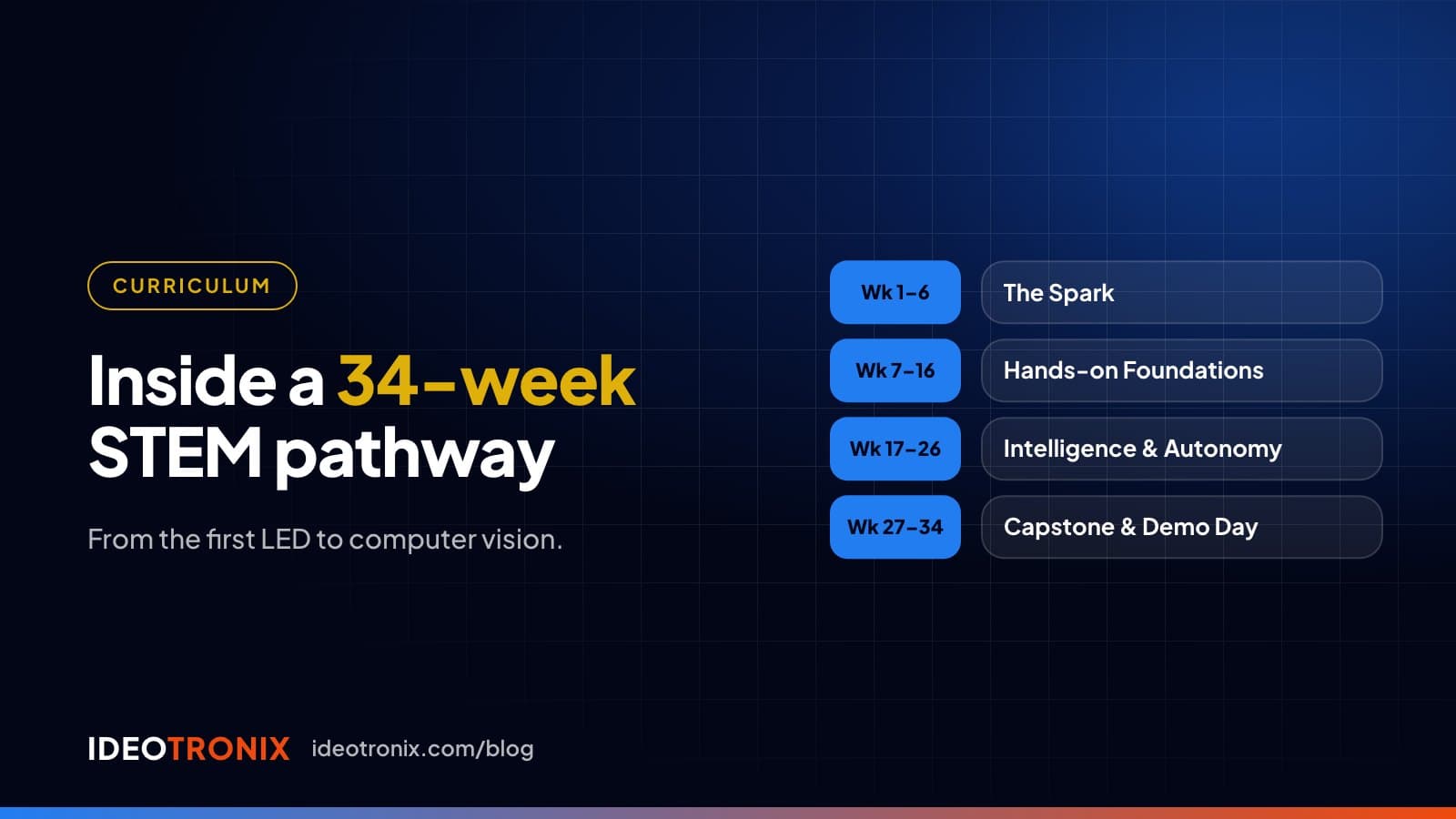
Ask students what they remember from a one-day robotics workshop and they'll describe the fun. Ask what they can still build a month later and the answer is often "not much". Lasting skills come from a structured pathway: each phase builds on the last and ends with a checkpoint that proves what students can do.
This is how the Ideotronix 34-week pathway is designed. It runs across about 170 hours of hands-on learning in four phases, each closed by a graded checkpoint.
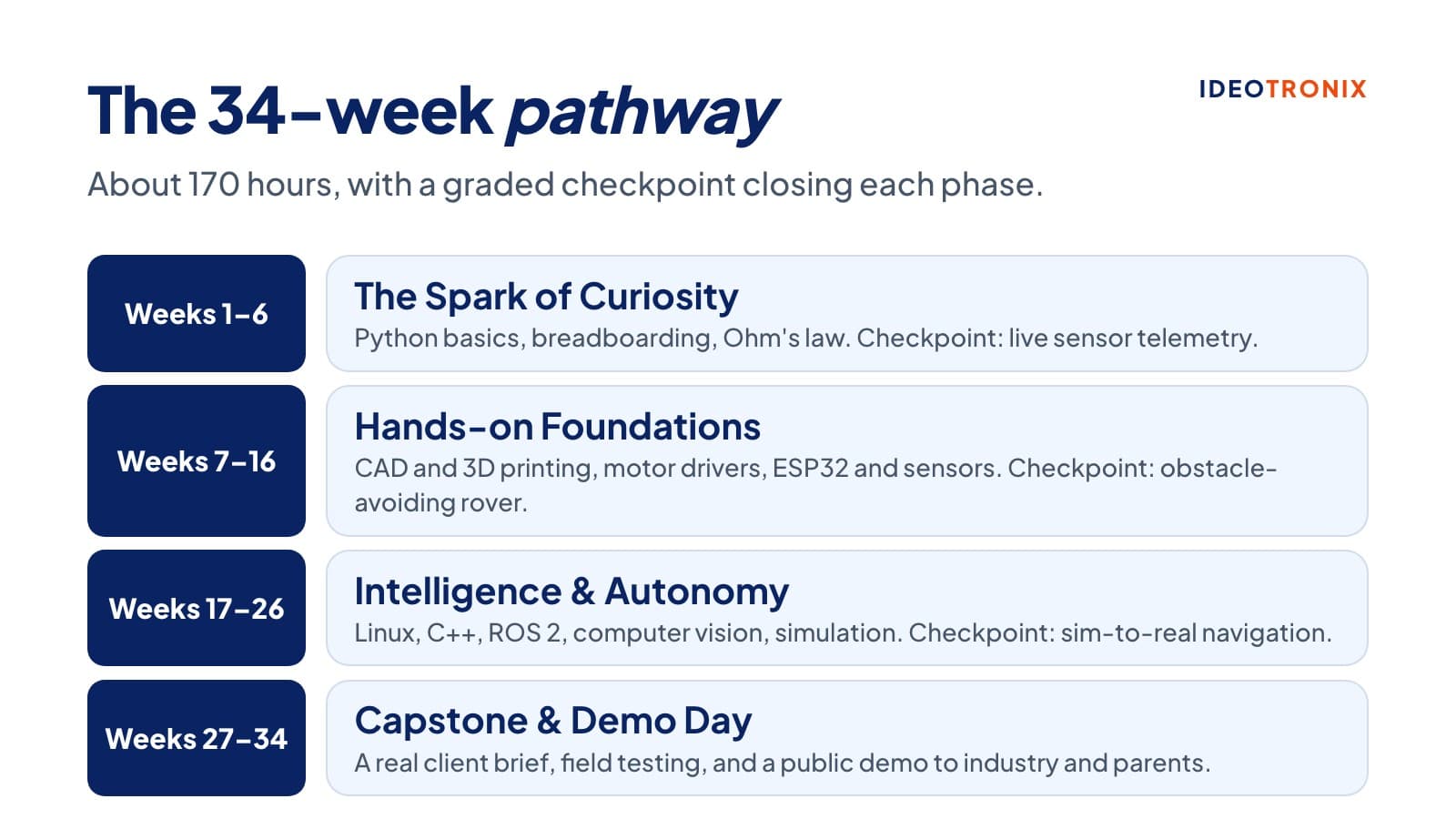
Phase 1 (Weeks 1 to 6): The Spark of Curiosity
Goal: turn technology from something intimidating into something students can command. In about 30 hours, students learn Python basics, breadboarding and Ohm's law, and get comfortable with the terminal and with saving their work using Git.
Checkpoint: a Python script that reads sensors on the breadboard and shows live data in the terminal. The moment an LED blinks from code they wrote, most students stop thinking of tech as "not for me".
Phase 2 (Weeks 7 to 16): Hands-on Foundations
Goal: master the physical side of engineering. Over about 50 hours, students learn CAD design and 3D printing, motor drivers, microcontrollers such as the ESP32, and the "sense, think, act" loop at the heart of every robot. They also learn to use a multimeter and to debug hardware patiently.
Checkpoint: an autonomous rover that finds its way through an unknown maze using distance sensors and motor control.
Phase 3 (Weeks 17 to 26): Intelligence & Autonomy
Goal: move from reactive robots to machines that perceive and decide. Over about 50 hours, students work with Linux, C++, ROS 2 (the Robot Operating System used in industry), computer vision with OpenCV, and simulation tools. They learn how robots map a room and plan a path.
Checkpoint: a robot navigation task built first in simulation and then transferred to real hardware, often called "sim to real".
Phase 4 (Weeks 27 to 34): Capstone & Demo Day
Goal: solve a real problem for a real client. Over about 40 hours, teams take a brief from a real user, design and field-test a solution, document it publicly and present it at demo day to industry guests, school leaders and parents. Skills in this phase include edge AI, power budgeting, client communication and pitching.
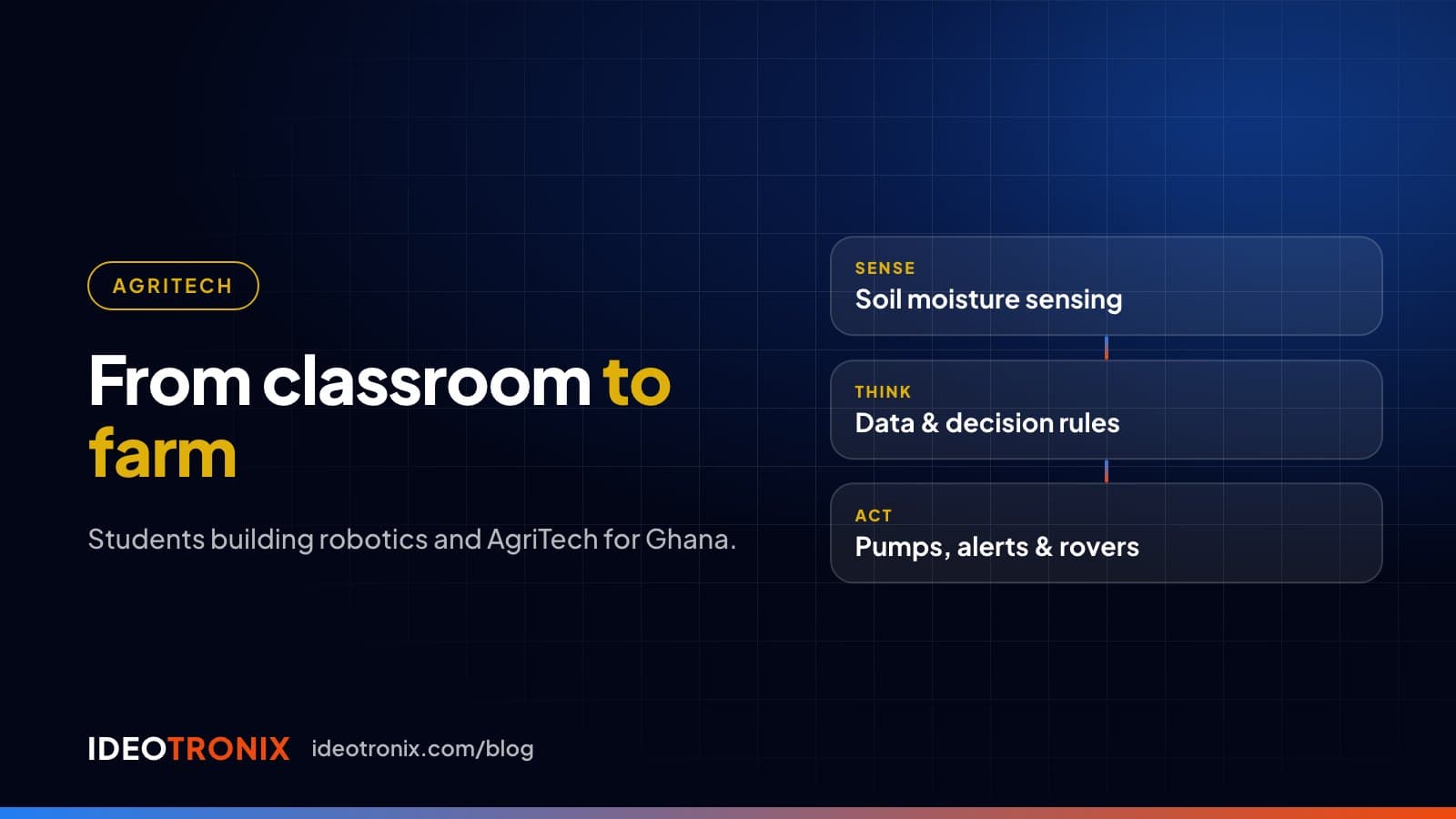
An example capstone is an agricultural scouting rover that monitors soil and spots crop disease. Read more in from classroom to farm.
Why this structure works
- Each phase unlocks the next, so students are never asked to do something they haven't been prepared for.
- Checkpoints make progress visible to students, teachers and parents, and give partners data to report. See how to measure STEM impact.
- Badges and credentials reward each milestone and build students' portfolios.
- The capstone gives purpose, connecting technical skills to real problems in Ghana.
| Phase | Weeks | Hours | Checkpoint |
|---|---|---|---|
| The Spark of Curiosity | 1 to 6 | About 30 | Live sensor telemetry in Python |
| Hands-on Foundations | 7 to 16 | About 50 | Obstacle-avoiding maze rover |
| Intelligence & Autonomy | 17 to 26 | About 50 | Simulation-to-real robot navigation |
| Capstone & Demo Day | 27 to 34 | About 40 | Field-tested solution presented publicly |
Frequently asked questions
What does a 34-week STEM curriculum cover?
The Ideotronix pathway covers about 170 hours in four phases: Python and electronics basics, hands-on robotics foundations (CAD, motors, microcontrollers and sensors), intelligence and autonomy (Linux, C++, ROS 2 and computer vision), and a real-world capstone presented at demo day.
How are students assessed in the curriculum?
Each phase ends with a graded checkpoint, such as a sensor telemetry script, an autonomous maze rover, a simulation-to-real navigation task and a field-tested capstone project.
Why use a structured curriculum instead of workshops?
Workshops spark interest but their gains fade quickly. A structured pathway builds skills step by step, with checkpoints that make progress visible and lasting.