
Every successful school STEM programme has one thing in common: teachers who are confident in the lab. Kits, curricula and software all depend on an adult who can guide students through a build, help them when they're stuck and keep the lab running term after term.
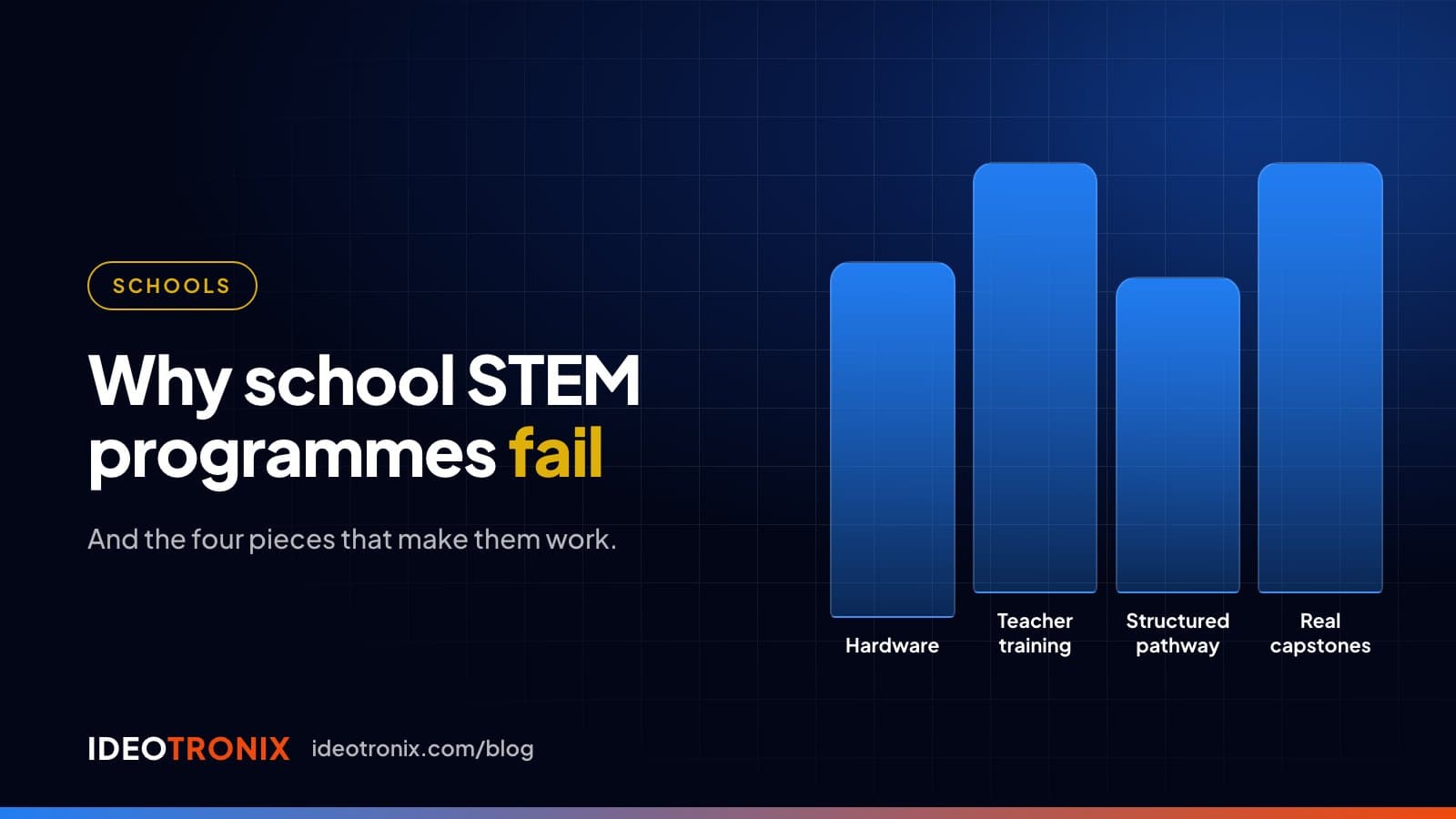
Yet teacher development is often the most neglected part of STEM investment. Schools buy equipment, run a single workshop, and hope for the best. The result is the "locked cupboard" we describe in why school STEM programmes fail.
The shift: from instructor to lab coach
| Traditional instructor | Lab coach |
|---|---|
| Explains the answer | Asks questions that help students find it |
| Students copy from the board | Students build, test and debug |
| Mistakes are marked wrong | Mistakes are part of the process |
| Teacher must know everything | Teacher learns alongside students and knows where to find help |
| Whole class does the same thing | Teams work at their own pace with roles |
This shift is just as important as technical knowledge, and it's what students remember most.
What STEM teachers need to learn
- Technical basics: circuits and Ohm's law, sensors and motors, block coding and Python, microcontrollers.
- Lab management: organising kits, tracking components, safety rules and storage.
- Facilitation: running team-based builds, assigning roles, managing mixed abilities.
- Debugging with students: a calm, step-by-step approach to fixing what doesn't work.
- Assessment: using rubrics and checkpoints to grade practical work.
- Inclusion: making sure every student, including girls, gets hands-on time. See girls in STEM.
Why one-off workshops aren't enough
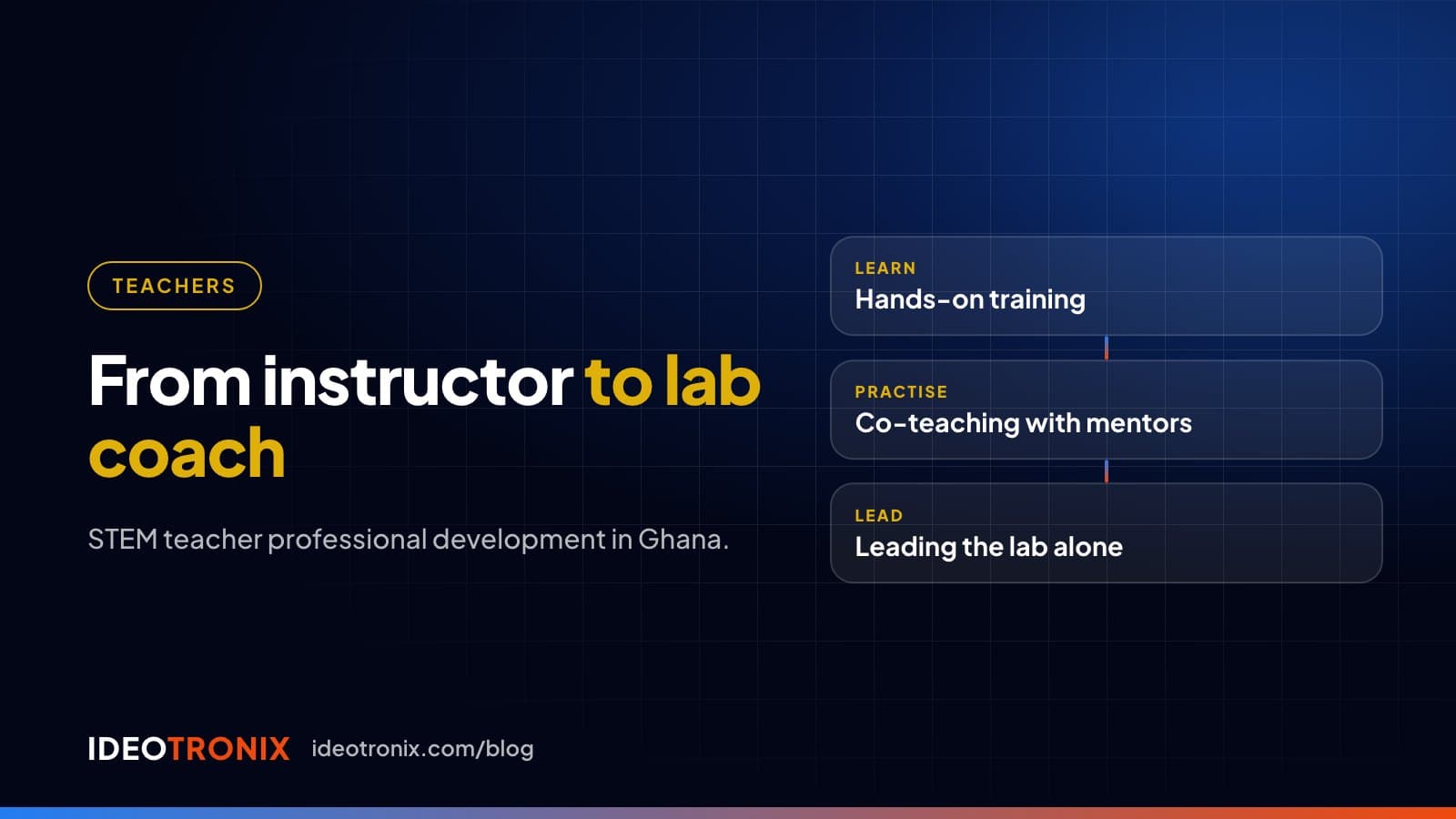
A one-day training session builds excitement, but teachers often lose confidence when they face a class alone a few weeks later. Lasting change needs practice with support: training, then co-teaching, then leading, with help available when needed.
A three-stage path to confident teaching
- Learn: hands-on training where teachers build the same projects their students will build, so they experience the challenges first.
- Practise: co-teach alongside an experienced instructor, gradually taking over sessions with feedback after each one.
- Lead: run the lab independently, with mentor office hours and refresher sessions when new modules start.
What school leaders can do
- Train at least two teachers so the programme survives if one leaves.
- Protect timetable time for practical sessions and for teacher preparation.
- Recognise STEM teachers publicly at demo days and in school communications.
- Measure teacher progress, such as training hours and sessions led independently. See measuring STEM impact.
How Ideotronix supports teachers
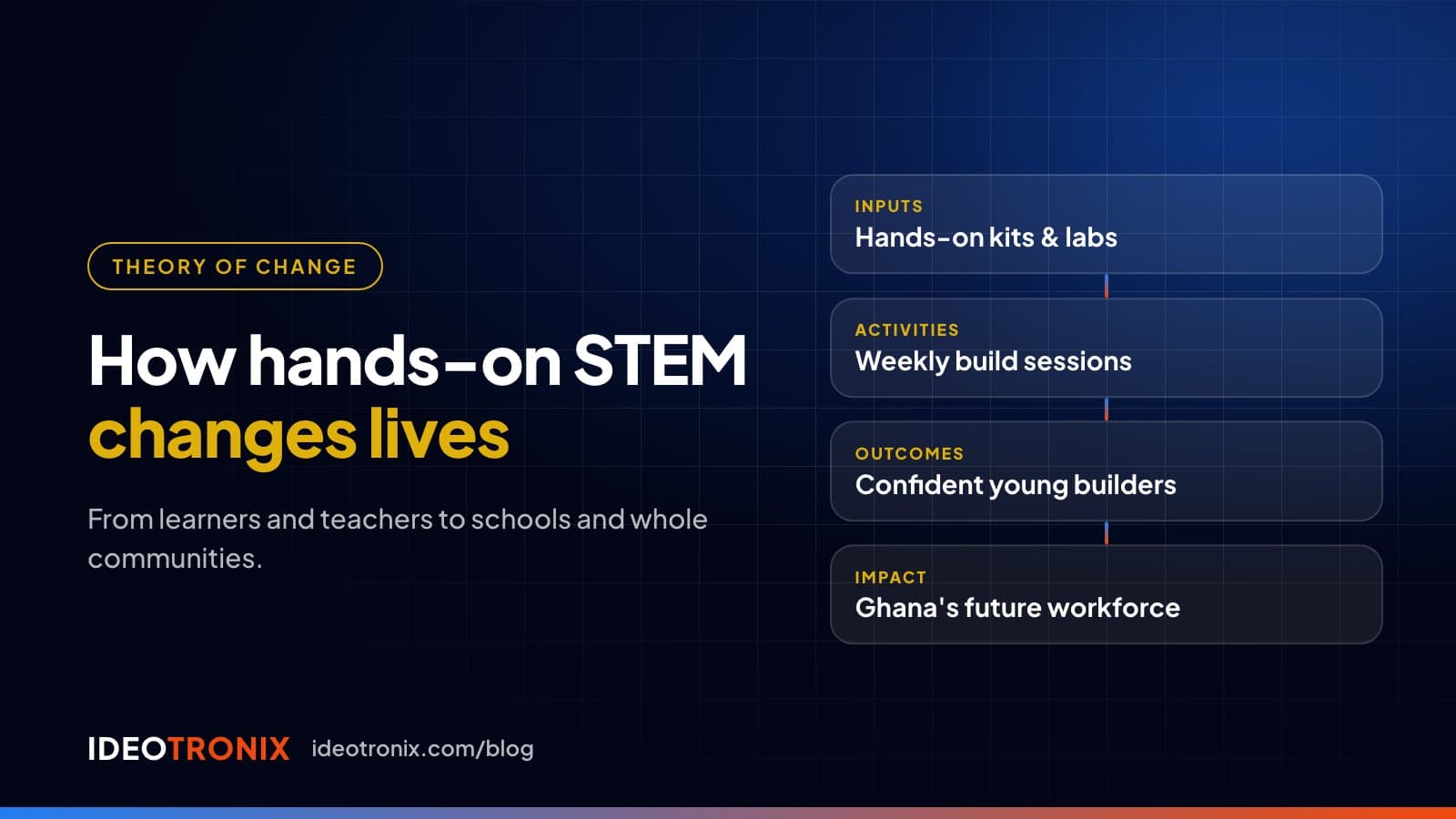
Teacher enablement is one of the four pillars of our theory of change. In partner schools, our trained instructors work alongside teachers, provide lesson guides and checkpoints, and offer ongoing support. We also run STEM and robotics workshops for teachers.
Frequently asked questions
How can teachers in Ghana get STEM training?
Through hands-on workshops, co-teaching with experienced instructors, and ongoing mentoring. Ideotronix provides training and support for teachers in partner schools and runs STEM and robotics workshops.
Do teachers need a technical background to teach robotics?
No. With hands-on training, lesson guides and support, teachers from science, maths and ICT backgrounds can confidently lead robotics and coding sessions.
Why are one-day STEM workshops for teachers not enough?
Confidence comes from practice. Teachers need to co-teach with support and have help available after training, or they often stop using the equipment.