
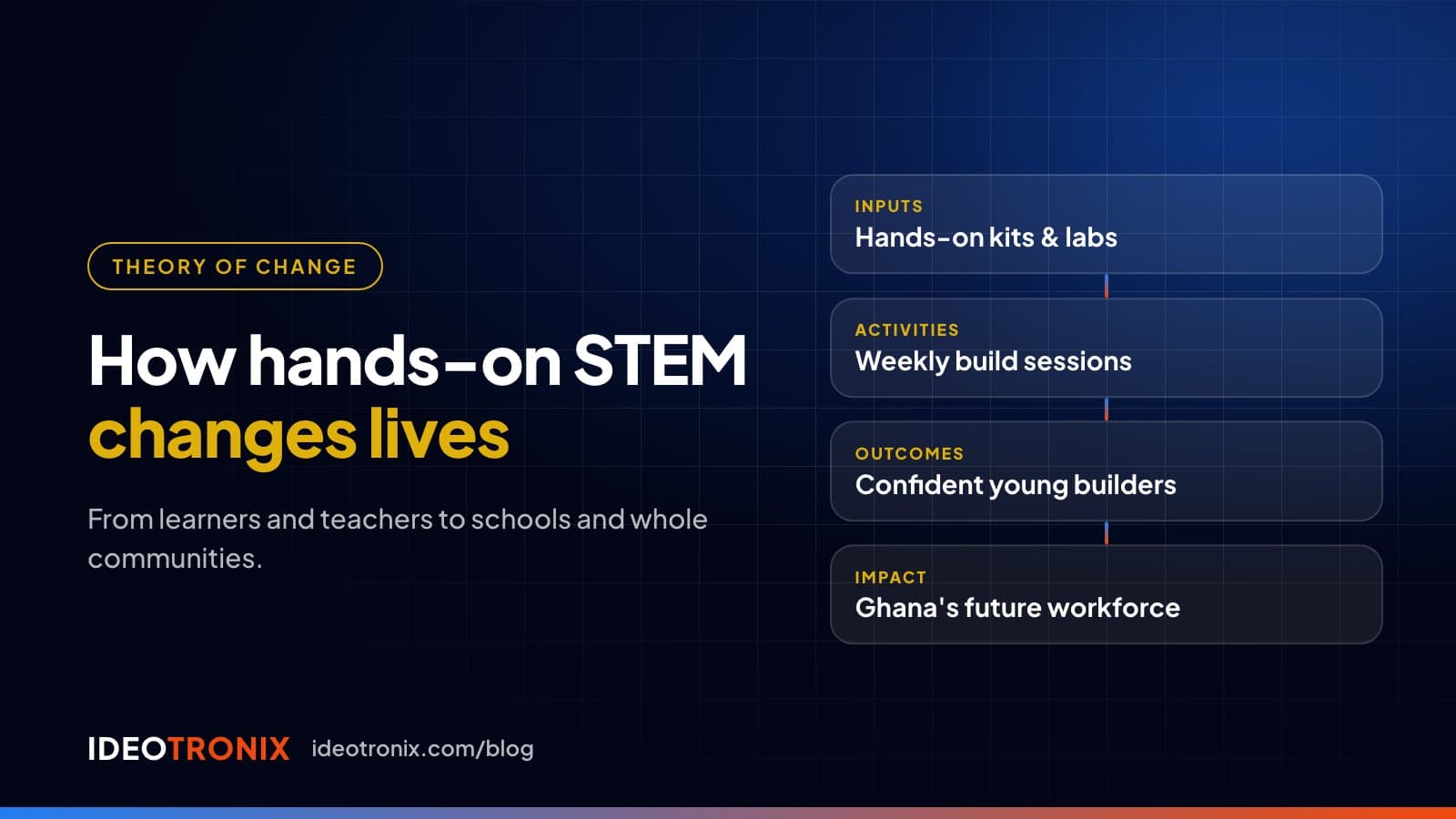
Partners, funders and school leaders often ask us a simple question: how exactly does a robotics kit in a classroom lead to a better future for Ghana? A theory of change is our answer. It sets out what we put in, what we do, what that produces, and the long-term change we expect, so anyone can test our logic and hold us to it.
This page explains the Ideotronix theory of change in plain language, for schools deciding whether to partner with us and for organisations deciding whether to invest alongside us.
The problem we exist to solve
Many Ghanaian students study science and ICT for years without ever building anything. Concepts like circuits, code and sensors stay abstract, so students memorise for exams and forget. Meanwhile, the jobs of the future increasingly need people who can design, build and debug real technology. The gap between what is taught and what is needed keeps widening.
We believe the gap is not about talent. Ghanaian students are as capable as students anywhere. It is about access to hands-on tools, teachers who are confident with them, and a structured path from first experiment to real-world project.
Our theory of change at a glance
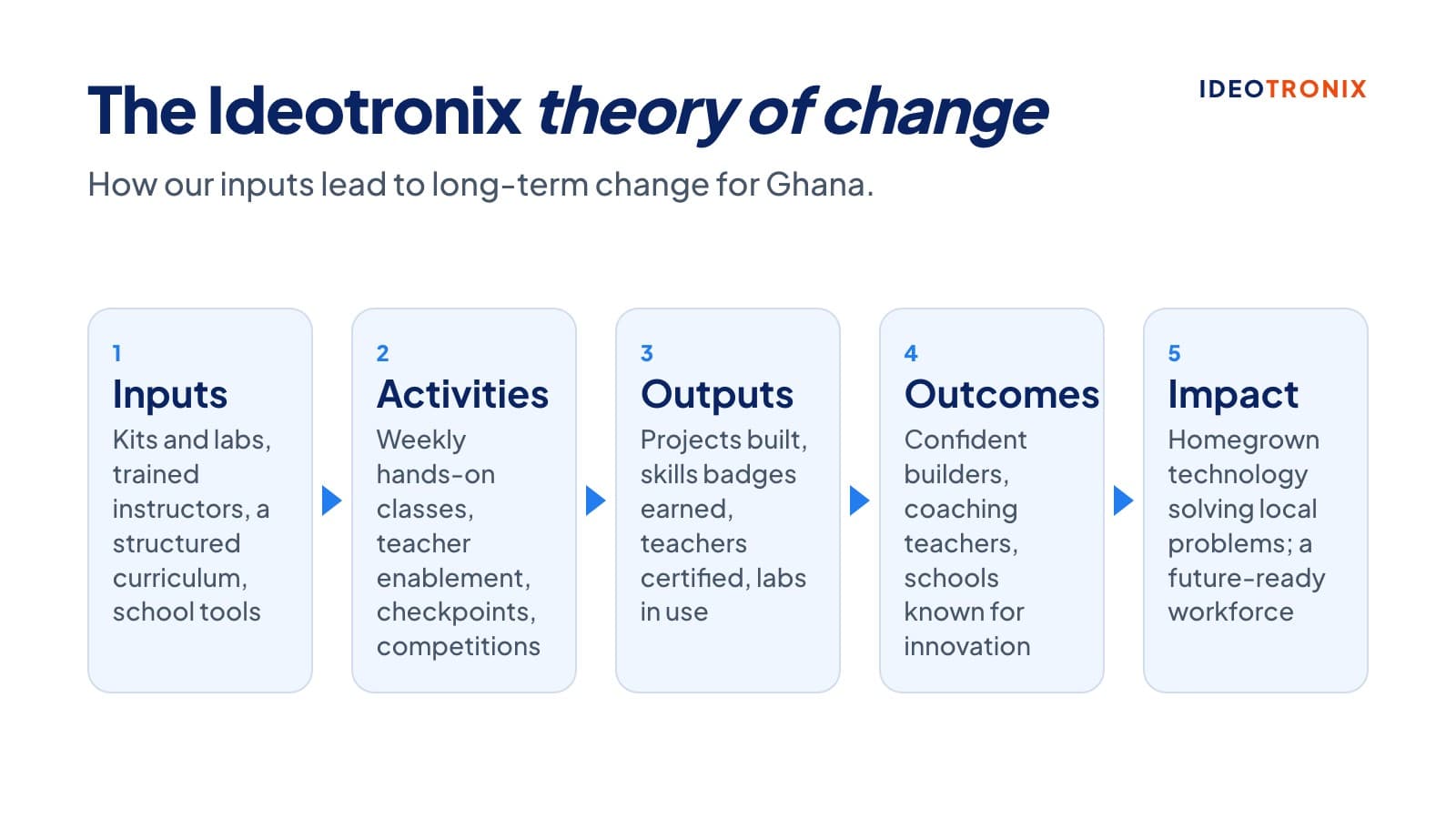
| Stage | What it means for Ideotronix |
|---|---|
| Inputs | Robotics and electronics kits, school STEM labs, trained instructors, a structured 34-week curriculum, teacher enablement, and school tools such as a website and AI management platform. |
| Activities | Weekly hands-on classes, teacher training and co-teaching, graded checkpoints, competitions, exhibitions and capstone projects. |
| Outputs | Projects built, skills badges earned, teachers trained, labs in regular use, students entering competitions. |
| Outcomes | Students who are confident builders and problem solvers, teachers who coach rather than lecture, schools known for innovation. |
| Impact | Young people using technology to solve local problems, and a pipeline of future-ready talent for Ghana's economy. |
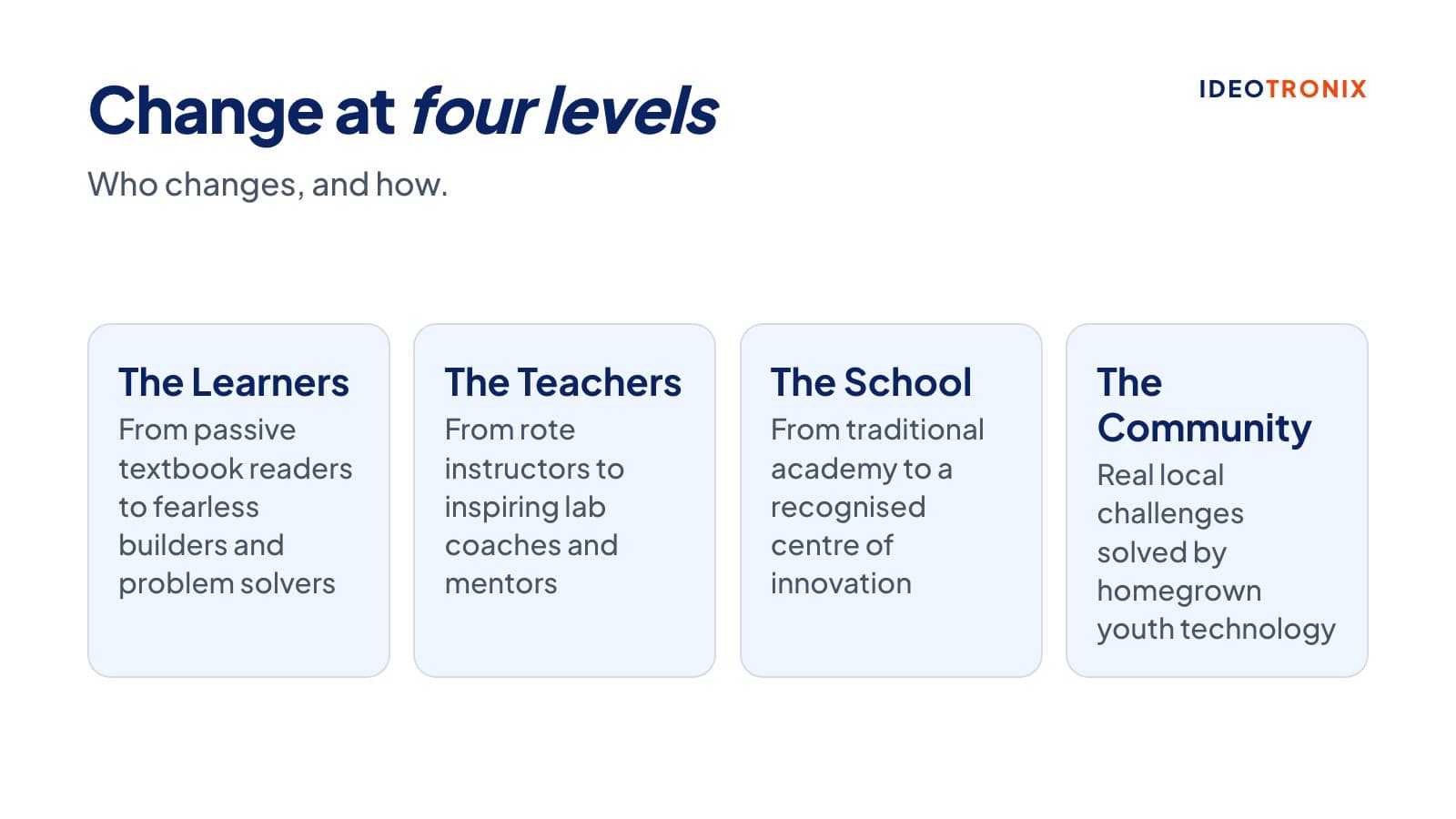
Change at four levels
Change does not happen to students alone. Our model works because it changes the whole system around them.
1. The learners
Students move from passive textbook readers to fearless builders and problem solvers. The first time a student writes code that makes an LED blink or a robot move, technology stops being something they consume and becomes something they command. Each phase ends with a graded checkpoint, so progress is visible and earned.
2. The teachers
Teachers move from rote instructors to inspiring lab coaches and mentors. With lesson guides, training and ongoing support, they stop worrying about preparing a curriculum from scratch and focus on guiding students. Read more in our guide to STEM teacher professional development.
3. The school
Schools move from traditional academies to recognised centres of innovation. A lab that is actually used, students entering competitions and projects shown at open days change how parents and the community see the school.
4. The community
Communities see real local challenges solved by homegrown youth technology. When capstone projects tackle problems such as farming, health or energy, families see what their children can do, and young people see that they don't have to wait until university to make a difference.
The assumptions behind our model
A good theory of change is honest about what must be true for it to work. Ours rests on four assumptions, each of which we design for:
- Students learn deeply by building. So every lesson ends with something made, not just something read.
- Teachers need support, not just equipment. So we train and accompany teachers instead of dropping off kits.
- Progress needs structure. So learning follows a 34-week pathway with checkpoints, not one-off workshops.
- Motivation comes from real purpose. So capstones connect to real Ghanaian problems.
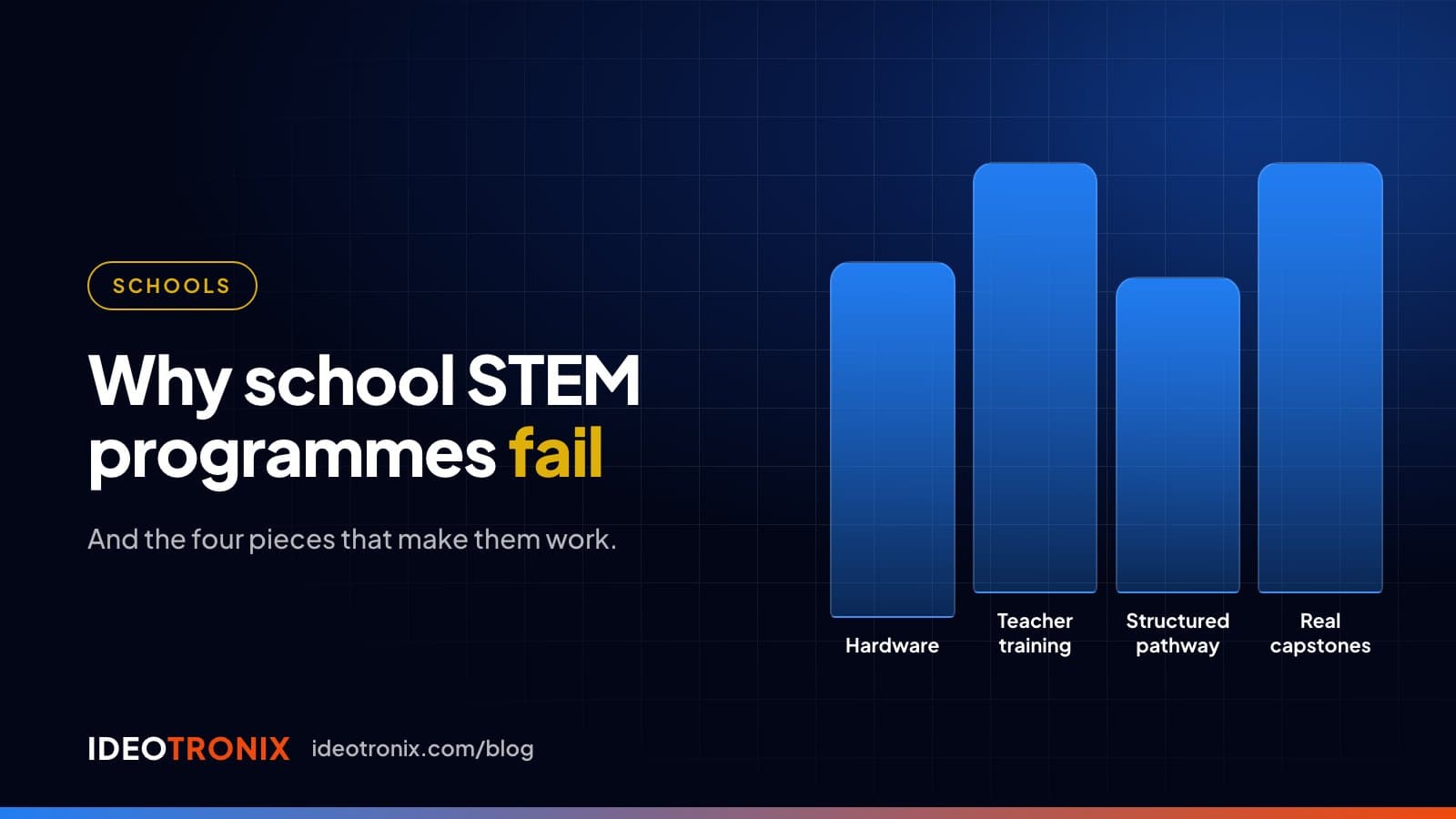
When any one of these is missing, programmes fail in predictable ways. We explain those failure modes in why school STEM programmes fail.
How we measure progress
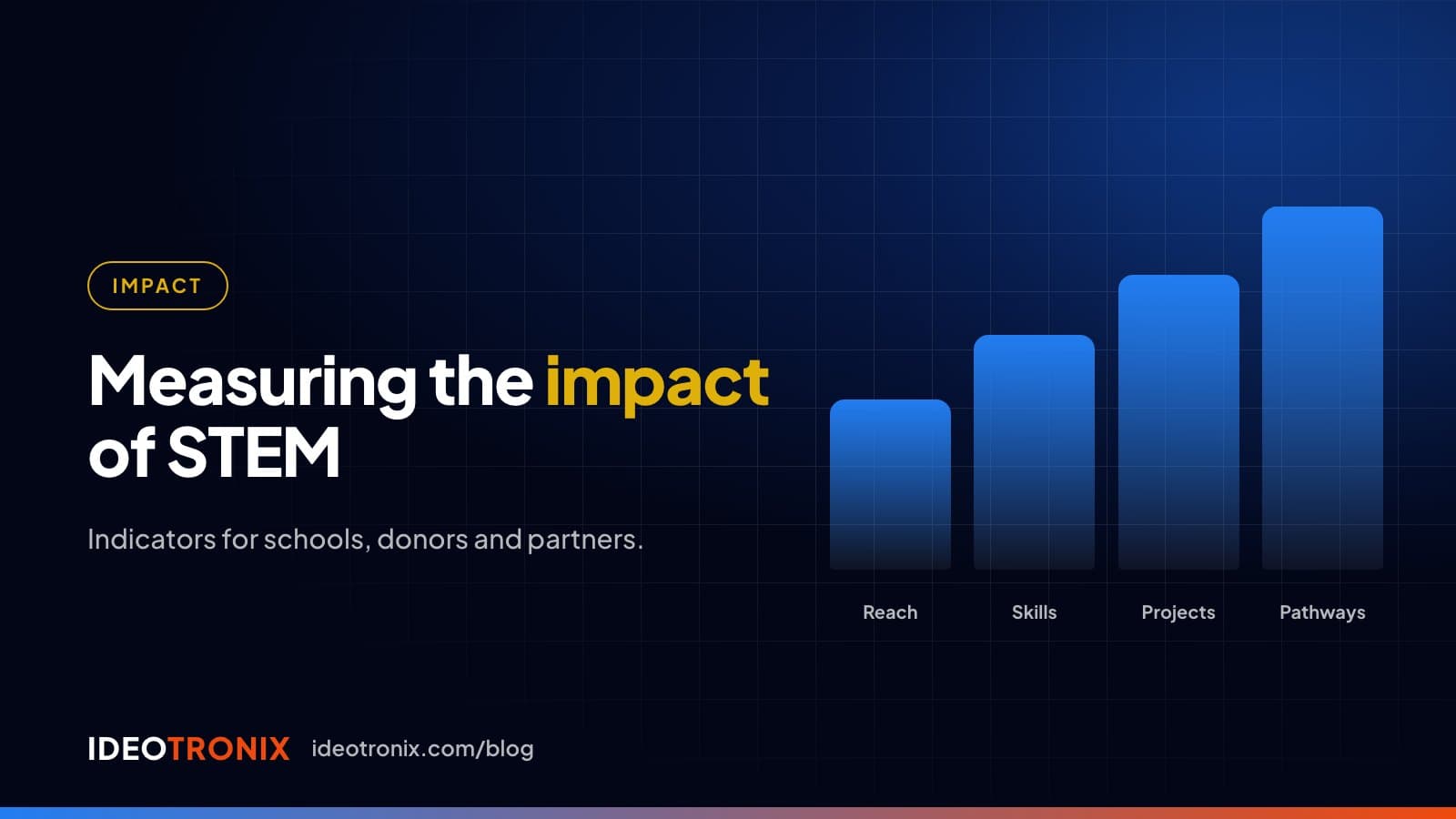
Each link in the chain has indicators we can track: attendance and enrolment for reach, checkpoint results and project rubrics for skills, surveys for confidence, training hours for teachers, and lab usage and competition entries for schools. We set out the full framework in how to measure the impact of a STEM programme.
What this means for partners and investors
- For schools: a complete programme that changes outcomes for students, teachers and the school's reputation.
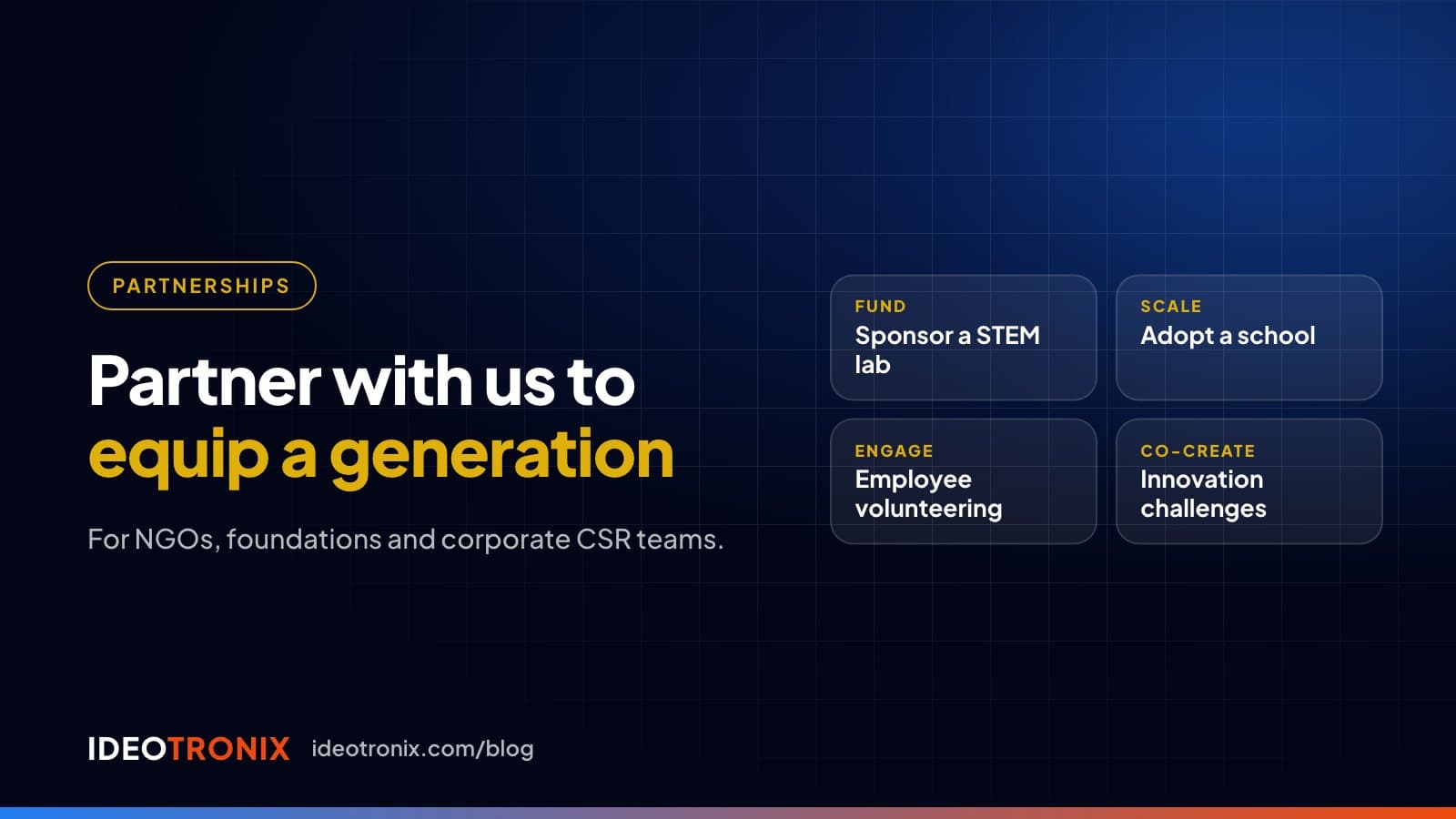
- For NGOs, foundations and CSR teams: a clear, measurable model you can fund, scale and report on. See how to partner with Ideotronix.
- For investors: a model that combines hardware, curriculum and school software, explained in EdTech in Ghana: the hands-on opportunity.
Frequently asked questions
What is a theory of change in education?
A theory of change explains how a programme's inputs and activities are expected to lead to outputs, outcomes and long-term impact, and the assumptions that must hold for that to happen. It helps partners understand, test and measure a programme.
What is the Ideotronix theory of change?
Ideotronix provides hands-on kits and labs, trained instructors, teacher enablement and a structured 34-week curriculum with real capstones. These produce confident student builders, teachers who coach, and schools known for innovation, leading to young people who use technology to solve local problems.
How does Ideotronix measure impact?
Ideotronix tracks reach (enrolment and attendance), skills (checkpoint results and project rubrics), confidence (surveys), teacher development (training hours and lessons led), and school outcomes such as lab usage and competition entries.