

Walk into any primary classroom in Ghana and you'll find girls who love building, experimenting and solving puzzles. Yet by senior high school and university, far fewer young women are choosing engineering, computing and technical subjects than young men. This gap is seen across Africa and the world.
The gap isn't about ability. It is about experience, expectations and opportunity, and those are things schools, parents and partners can change.
Why girls drift away from STEM
- Stereotypes: the idea that robotics and coding are "for boys" is picked up early, from media, toys and casual comments.
- Few visible role models: girls rarely see women engineers, programmers or scientists in their community.
- Less hands-on experience: boys are more often given building toys and gadgets, so girls may arrive at the lab with less confidence.
- Group dynamics: in mixed groups, the most confident students tend to take control of the kit while others watch.
- Fear of failure: girls are often under more pressure to get things right first time, while STEM depends on trial and error.
What works: practical approaches
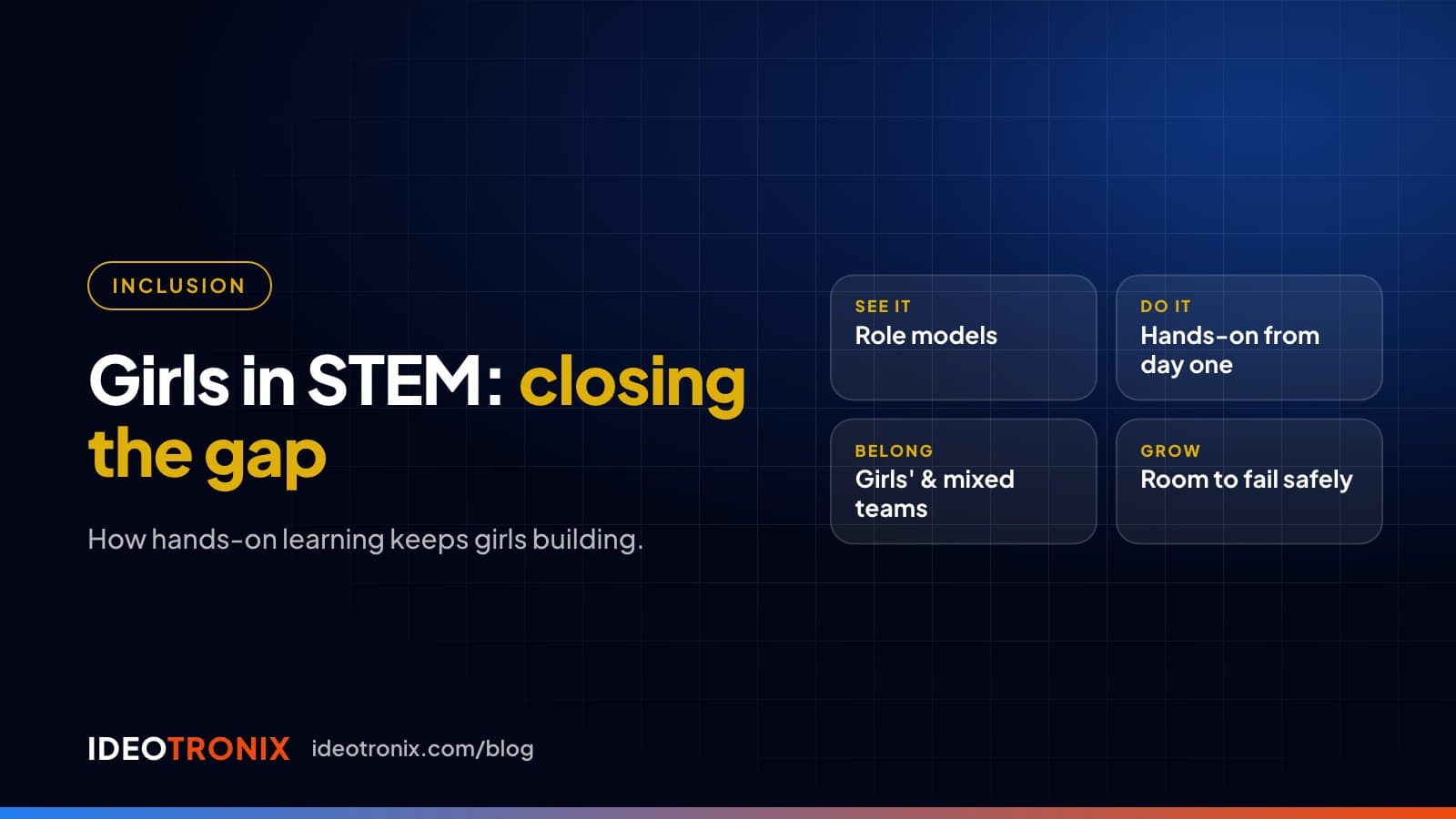
1. Hands-on from day one
Confidence comes from doing. When every student, not just the boldest, gets their hands on a kit in the first lesson, the "I'm not a tech person" story is broken early. Give each student a defined role and rotate roles so everyone builds, codes and presents.
2. Visible role models
Invite women engineers, developers and scientists to speak, mentor or judge competitions. Share stories of African women in technology. Female STEM teachers and instructors are powerful role models in their own right.
3. Girls' teams and mixed teams
Girls-only clubs or teams can give girls space to lead and experiment. In mixed classes, use structured roles so the kit isn't dominated by a few students. Both approaches work best when used together.
4. Projects with purpose
Many students, girls included, are motivated by projects that help people. Health monitors, smart farming tools and safety devices connect technology to real needs. See student AgriTech projects for examples.
5. Room to fail safely
Celebrate debugging. When teachers model that "it didn't work, let's find out why" is a normal part of engineering, students become more willing to take risks.
What parents can do
- Give daughters building kits, coding games and electronics projects, not just sons.
- Talk about careers in engineering, software and science as realistic options.
- Ask about the school's STEM programme and whether girls take part equally.
- Encourage holiday camps and clubs. See our guide to STEM holiday camps in Ghana.
What schools and partners can do
- Track participation by gender every term so drop-off is spotted early. See measuring STEM impact.
- Train teachers in inclusive facilitation, such as role rotation and mixed-confidence grouping.
- Enter girls' teams into STEM and robotics competitions.
- Fund girls-in-STEM initiatives such as clubs, camps and scholarships, a common priority for CSR and foundation partners. See how to partner with Ideotronix.
Frequently asked questions
Why are there fewer girls in STEM?
Not because of ability. Stereotypes, a lack of visible role models, less hands-on experience growing up, group dynamics in the classroom and fear of failure all push girls away from STEM over time.
How can schools encourage girls in STEM?
Give every student hands-on time from the first lesson, rotate roles in group work, bring in women role models, run girls' teams and clubs, use purposeful projects, and track participation by gender every term.
How can parents support their daughters in STEM?
Provide building and coding toys, talk about STEM careers as real options, ask about equal participation in the school's programme, and encourage camps and clubs.