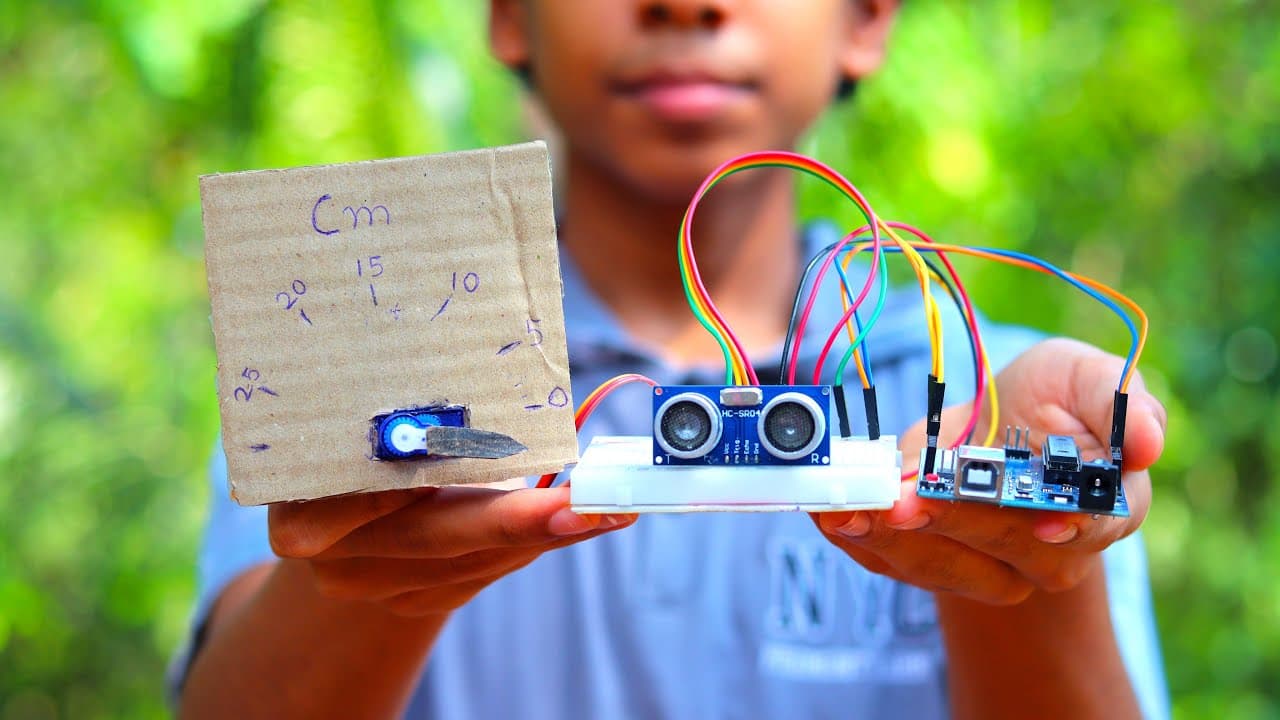

Agriculture employs a large share of Ghanaians and feeds the whole country. It also faces real challenges: unpredictable rainfall, pests and crop disease, soil health, and the cost of labour and water. Many of these are problems technology can help with.
That makes farming one of the best contexts for student STEM projects. Students can see the problem, talk to the people who face it, and build something that might actually help. It's the "real-world capstone" at the heart of our theory of change.
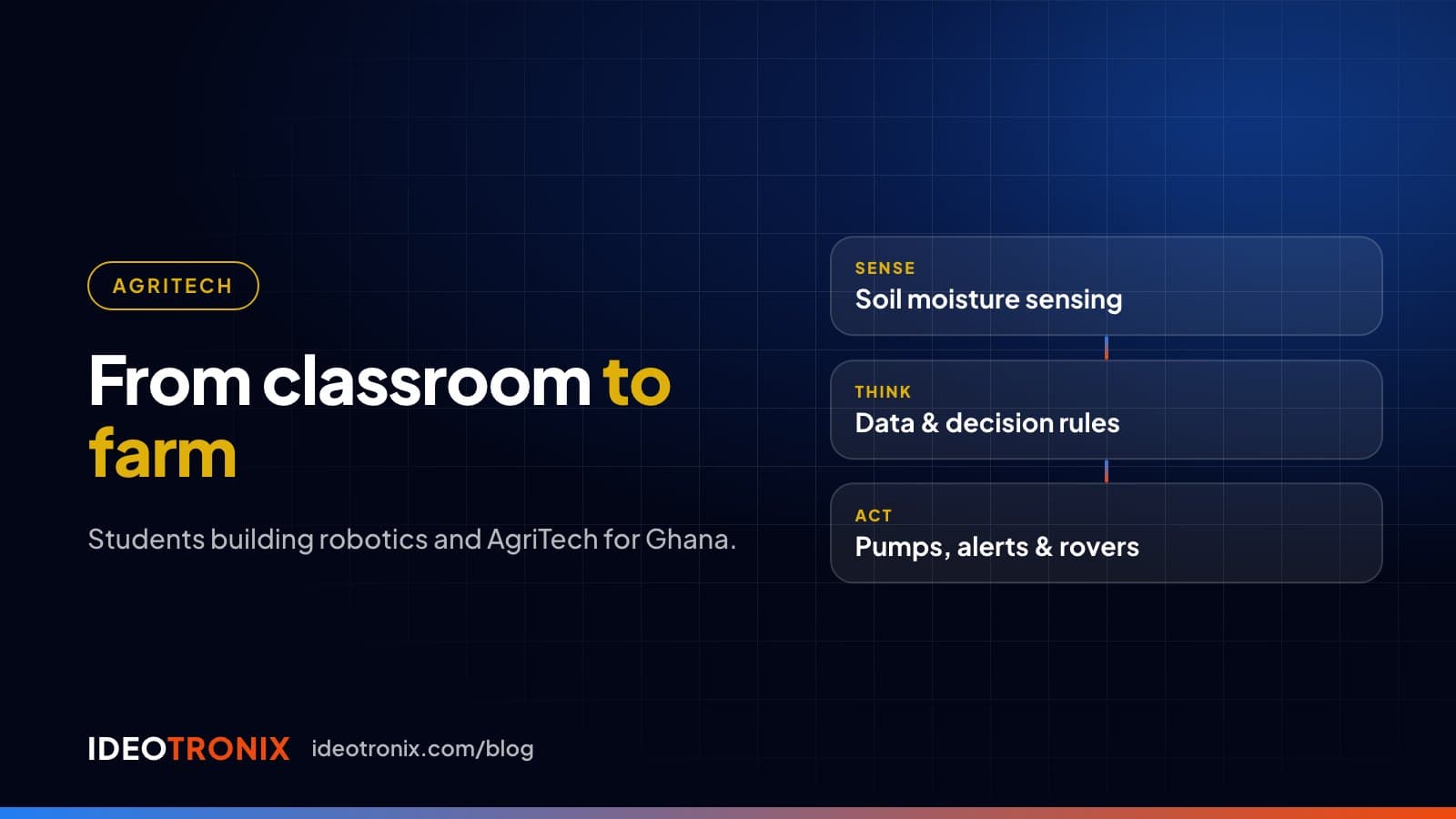
Sense, think, act: how AgriTech devices work
Almost every smart farming device follows the same loop that students learn in robotics:
- Sense: sensors measure soil moisture, temperature, humidity, light or even images of leaves.
- Think: a microcontroller applies rules ("if the soil is dry, water") or an AI model makes a prediction.
- Act: the device switches a pump, sends an SMS alert, logs data or moves a robot.
AgriTech project ideas by level
| Level | Project | Skills learned |
|---|---|---|
| Beginner | Soil moisture alarm that beeps or lights up when a plant needs water | Sensors, conditions, basic circuits |
| Beginner | Greenhouse climate monitor showing temperature and humidity | Reading sensors, displaying data |
| Intermediate | Automatic irrigation that switches a pump based on soil moisture | Relays, pumps, control logic |
| Intermediate | Farm data logger that sends readings to a phone or dashboard | IoT, Wi-Fi, data visualisation |
| Intermediate | Animal or bird deterrent triggered by motion | Motion sensors, buzzers, timing |
| Advanced | Solar-powered scouting rover that drives along crop rows | Motors, navigation, power budgeting |
| Advanced | Leaf disease detector using an AI camera | Computer vision, training data, edge AI |
Kits such as the Smart Agriculture kit and Smart Greenhouse kit are a quick way to start, while the Smart AI Lens kit brings computer vision within reach.
What an advanced capstone looks like
In the final phase of our 34-week curriculum, we use an agricultural scouting rover as an example capstone: a solar-powered robot that drives along farm rows, logs soil readings and uses an AI camera to spot early signs of leaf disease. It brings together everything students have learned: motors and sensors, navigation, computer vision and power management.
Not every school needs to start this ambitiously. A simple moisture alarm built for the school garden teaches the same "sense, think, act" loop.
How to run an AgriTech project well
- Start with a real user. Visit a farm, school garden or market. Ask what problems people face before deciding what to build.
- Define success. "The pump turns on when soil moisture falls below a set level" is testable; "help farmers" is not.
- Prototype small, then test outdoors. Sun, dust and rain behave very differently from a classroom.
- Mind the power. Many farms lack reliable electricity, so think about batteries and solar from the start.
- Get feedback. Show the prototype to the user and improve it.
- Present it. Demo days, science fairs and competitions reward projects with a clear local purpose.
Frequently asked questions
What are good AgriTech projects for students?
Good projects include a soil moisture alarm, a greenhouse climate monitor, automatic irrigation, a farm data logger, a motion-triggered animal deterrent, a crop scouting rover and an AI leaf disease detector.
How is robotics used in agriculture?
Robotics and connected sensors can monitor soil and weather, automate irrigation, scout crops for pests and disease, and collect data that helps farmers make better decisions.
What kit do students need for smart farming projects?
A microcontroller such as a micro:bit, Arduino or Raspberry Pi Pico, plus sensors (soil moisture, temperature, humidity), a small pump or relay, and optionally an AI camera for advanced projects.