
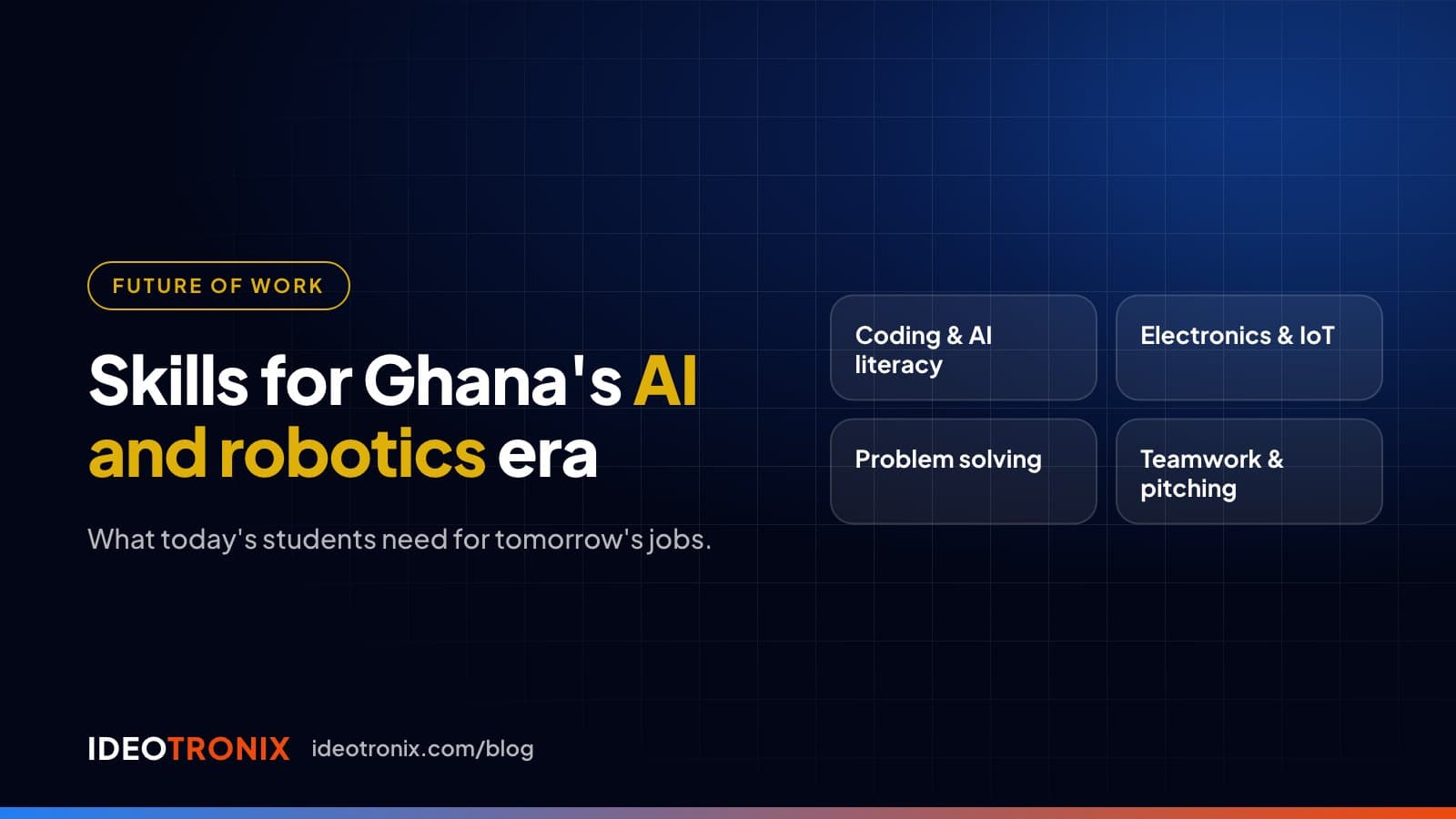
The students sitting in Ghanaian classrooms today will spend most of their careers in a world shaped by what is often called the Fourth Industrial Revolution (4IR): artificial intelligence, robotics, connected devices and automation. Some jobs will change, some will disappear and many new ones will be created.
No one can predict exactly which jobs will exist in 2040. But we can say with confidence which skills will matter, and most of them can be built in school, starting now.
Technical skills that will matter
| Skill | Why it matters | How students start |
|---|---|---|
| Coding | Software runs almost every industry, from banking to farming | Block coding, then Python. See coding for kids in Ghana |
| AI literacy | Knowing how AI works, where it fails and how to use it well | Train simple models, explore AI cameras. See teaching AI to students |
| Electronics and IoT | Connected sensors and devices are spreading across agriculture, energy and health | Circuits, sensors and microcontrollers |
| Robotics and automation | Machines are taking on repetitive and dangerous tasks | Robot cars, motors and control loops |
| Data skills | Decisions in every sector rely on data | Logging sensor data, making simple charts |
| Design and prototyping | Turning ideas into working products | CAD, 3D printing and iterative builds |
Human skills machines can't replace
- Problem solving: breaking a messy problem into steps and testing solutions.
- Creativity: imagining new uses for technology in a local context.
- Collaboration: working in teams with different strengths.
- Communication and pitching: explaining an idea clearly to users, judges or investors.
- Resilience: debugging, failing and trying again.
- Ethics and judgement: asking whether a technology is fair, safe and useful.
Hands-on STEM builds both kinds of skill at once. A team building a robot has to code it, wire it, fix it when it fails, share the work and then present it. That combination is hard to teach from a textbook.
Why this matters for Ghana
- A young population means the skills built in school today shape the economy for decades.
- Local problems need local builders: agriculture, energy, health and transport all benefit from technology designed with local knowledge.
- Jobs are increasingly global: skilled young people can work with companies anywhere, from Ghana.
- Entrepreneurship: students who can build are better placed to start companies, not just look for jobs.
How schools can start today
- Make it practical: give students real hardware and real code every week, not just theory.
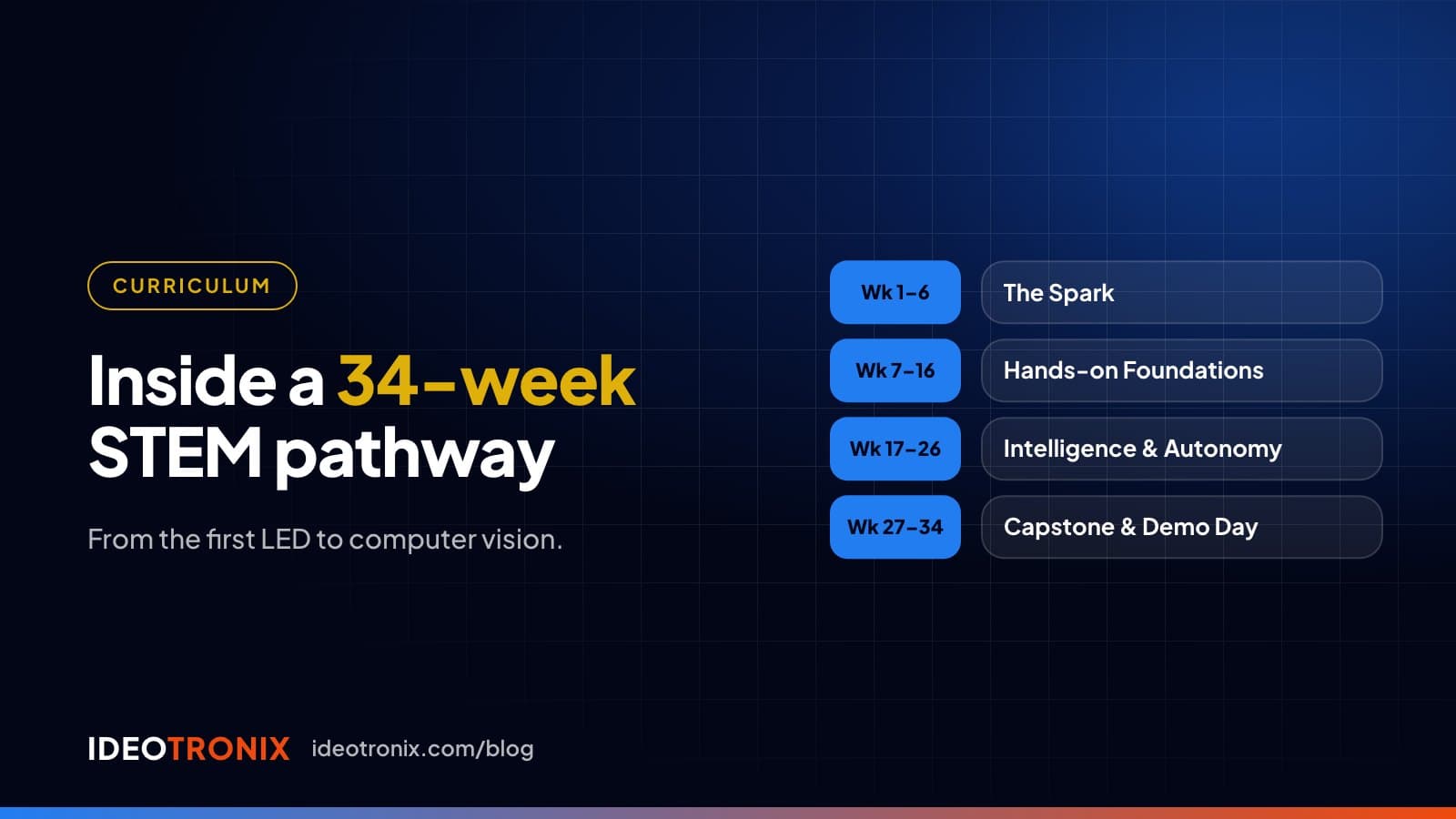
- Make it structured: follow a pathway that builds skills phase by phase. See our 34-week STEM curriculum.
- Make it real: set projects that solve local problems.
- Make it visible: enter competitions and hold demo days so students practise presenting.
- Equip teachers: invest in STEM teacher training.
Frequently asked questions
What skills will students need for the future of work?
Technical skills such as coding, AI literacy, electronics, robotics, data and prototyping, combined with human skills like problem solving, creativity, collaboration, communication, resilience and ethical judgement.
What is the Fourth Industrial Revolution?
The Fourth Industrial Revolution (4IR) describes the current wave of change driven by artificial intelligence, robotics, connected devices and automation, which is reshaping industries and jobs.
How can schools in Ghana teach future skills?
By making STEM practical and structured: hands-on hardware and coding every week, a phased curriculum, projects that solve local problems, competitions and demo days, and well-trained teachers.